Artificial intelligence is transforming workplaces at remarkable speed. Businesses are increasingly using AI to write reports, summarise meetings, analyse data and improve productivity.
But recent headlines surrounding KPMG AI report hallucinations offer an important warning. Even some of the world’s biggest professional firms can encounter problems when artificial intelligence is not properly checked.
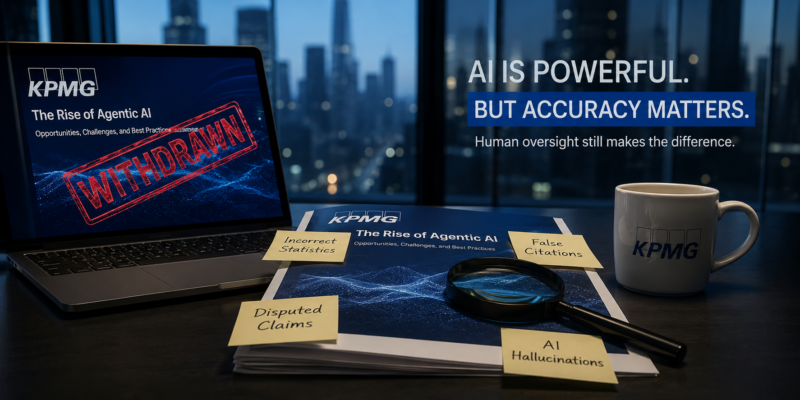
This story is not really about whether AI is good or bad. It is about using AI responsibly.
What Happened With The KPMG AI Report?
According to reports, KPMG published a report exploring the rise of advanced artificial intelligence systems, sometimes described as “agentic AI”.
However, concerns were later raised about whether some of the report’s examples were accurate.
Major organisations reportedly disputed claims about how they were using AI, while researchers suggested some references and citations may have been inaccurate or misleading.
KPMG later removed the report from some locations and reportedly launched an internal review into how it had been produced.
For one of the world’s largest professional services firms, this was clearly uncomfortable.
The KPMG AI report hallucinations story quickly became a reminder that even highly experienced organisations can make mistakes if AI generated content is not properly verified.
What Are AI Hallucinations?
An AI hallucination occurs when artificial intelligence generates information that sounds convincing but is actually incorrect, misleading or completely false.
This can include:
- Incorrect statistics
- Made up references
- False citations
- Misrepresented case studies
- Exaggerated claims
The challenge is that modern AI systems are designed to sound confident and professional.
A document may appear polished and well researched while still containing errors underneath the surface.
That is why human checking still matters.
Many people wrongly assume AI mistakes are obvious. In reality, some errors can appear highly believable unless someone takes the time to verify the information properly.
KPMG Is Not The Only Story
The KPMG AI report hallucinations issue is not happening in isolation.
Recent reports have also highlighted concerns involving other major firms.
EY reportedly withdrew a report after questions were raised about references and citations that appeared inaccurate.
This highlights a growing challenge for businesses adopting artificial intelligence at speed.
AI can dramatically improve efficiency, reduce workload and help teams work faster. But if organisations rely too heavily on automated output without checking facts, mistakes can quickly become public.
In industries such as finance, healthcare, law and taxation, accuracy matters enormously.
Incorrect information can damage trust, create reputational problems and in some cases even lead to legal or compliance risks.
Why Human Oversight Still Matters
Stories like this should not be seen as a reason to avoid artificial intelligence.
The reality is that AI is already creating enormous benefits.
Businesses are using artificial intelligence to:
- Improve customer service
- Analyse large amounts of data
- Detect fraud
- Support research
- Create content
- Automate repetitive tasks
The technology is clearly powerful.
However, the KPMG AI report hallucinations story highlights an important lesson.
AI should be treated as an assistant, not a final decision maker.
If a junior employee drafted an important report, most organisations would check the content carefully before publication.
Artificial intelligence should be treated exactly the same way.
Human judgement, experience and accountability still matter.
Why AI Literacy Is Becoming Essential
Ironically, stories like this actually strengthen the argument for learning about artificial intelligence properly.
The answer is not fear.
The answer is understanding.
People increasingly need to know:
- How to fact check AI generated content
- When artificial intelligence may make mistakes
- How to question AI output
- Why human review still matters
In many workplaces, AI literacy may soon become as important as digital literacy.
Those who understand both the strengths and weaknesses of AI are likely to be in a far stronger position than those who ignore it completely.
Final Thoughts
The KPMG AI report hallucinations story should not be viewed as proof that artificial intelligence is failing.
Instead, it is a reminder that powerful technology still requires responsible use.
Artificial intelligence is improving rapidly and is already reshaping workplaces around the world.
But faster does not always mean better if nobody checks the output.
The businesses and professionals who benefit most from AI may not necessarily be the ones using it the most.
They will likely be the ones using it wisely.
At AI Tuition Hub, we believe the answer is not to fear artificial intelligence but to understand it properly. With more than 110 AI courses covering business, finance, healthcare, online safety, productivity and much more, the goal is to help people use AI confidently and responsibly.
New members can also currently use the FOUNDER50 offer to receive 50% off their first month while exploring the platform and learning more about how artificial intelligence is changing the modern world.
Further reading – EY report withdrawal following AI hallucination concerns