Almost every week, there seems to be another headline about AI job losses and the impact of Artificial Intelligence on work. One company announces restructuring. Another introduces automation. A new report predicts changes to office based work, trainee opportunities, or administrative roles.
From finance and customer service to administration, legal support, marketing, and operations, AI is increasingly changing how work gets done.
Understandably, many people are asking:
How to Stay Competitive Despite AI Job Losses
At AI Tuition Hub, we believe the answer is not panic.
It is preparation.
That is why we have recently reviewed and refreshed one of our most practical and important courses:
Updated Course: Learning AI to Stay Competitive in Today’s Job Market
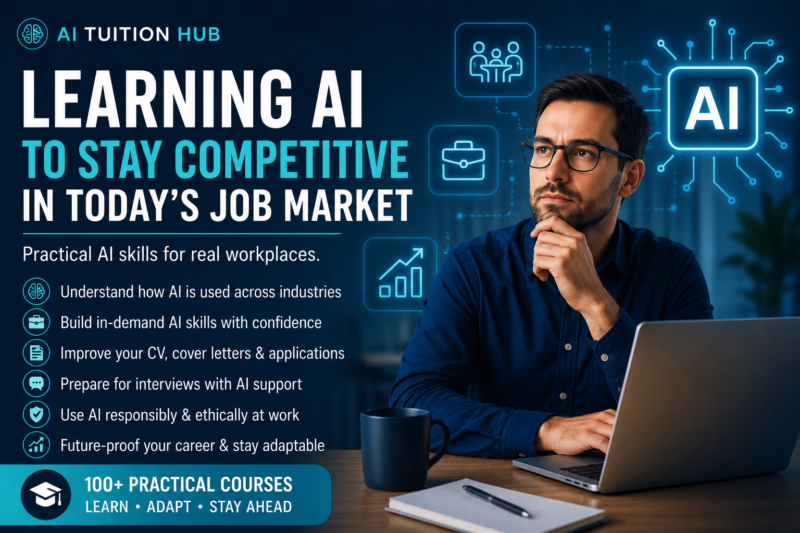
At AI Tuition Hub, we regularly review and update our courses as AI continues evolving across industries and professions. Workplace expectations are changing quickly, and what felt new only a few months ago can rapidly become standard practice.
While nobody can predict the future perfectly, one thing is becoming increasingly clear:
The people most likely to thrive are those who learn how to work alongside AI, rather than ignore it.
Importantly, this course is not designed for programmers or technical experts.
You do not need to understand coding, machine learning, or complicated systems.
This course is designed for:
- everyday professionals
- job seekers
- career changers
- people worried about workplace change
- anyone wanting to improve career resilience
Whether you work in administration, finance, healthcare, education, retail, customer service, operations, or management, practical AI literacy is increasingly becoming part of modern professional life.
The goal of this course is simple:
Help people stay informed, adaptable, and competitive in a changing world of work.
The Essential AI Skills Employers Look For
The course begins by exploring the practical AI skills employers increasingly value.
Rather than focusing on technical complexity, this lesson looks at:
- writing better prompts
- improving communication
- organising information
- analysing content more efficiently
- understanding responsible AI use
Many employers are not looking for AI experts.
They are increasingly looking for people who can use workplace tools confidently and responsibly. This lesson explains what that actually looks like in practice.
How AI Is Used in Real Workplaces Across Job Roles
AI does not affect every profession in the same way. In this lesson, we explore how AI is already being used across real workplaces and industries.
You will discover practical examples from:
- administration
- finance
- customer service
- logistics
- healthcare
- education
- creative roles
Instead of dramatic headlines, we focus on what is actually happening right now.
Because in many industries, jobs are evolving rather than disappearing completely.
Understanding that difference helps reduce uncertainty and gives people a clearer idea of where opportunities may still exist.
Building Your AI Confidence With Simple Tools
Many people still feel intimidated by AI. This lesson is designed to remove that fear.
You will learn:
- beginner friendly ways to use AI
- how to improve prompts
- practical everyday uses
- how to experiment safely
- common mistakes to avoid
One of the biggest misconceptions about AI is that it is only for technical specialists.
It is not.
If you can send an email, organise a task list, or search online, you can begin learning practical AI skills.
Confidence tends to grow quickly once people realise that AI can support work rather than replace them entirely.
Using AI to Improve Your CV, Résumé, and Cover Letters
Job applications are becoming more competitive. At the same time, many employers increasingly use digital systems and applicant tracking software.
This lesson explores how AI can help improve:
- CV wording
- professional summaries
- cover letters
- job applications
- tailoring experience to specific roles
The focus remains on presenting yourself more clearly, not exaggerating your experience.
Many people undersell themselves. AI can help structure achievements and improve clarity while remaining authentic.
Preparing for Interviews With AI Support
Interviews can feel stressful, particularly when confidence feels low.
This lesson explores how AI can support interview preparation in practical ways.
You will learn how to:
- generate realistic interview questions
- improve answers using the STAR framework
- prepare for behavioural questions
- structure clearer responses
- identify stronger examples from your own experience
As employers increasingly ask about digital confidence and adaptability, interview preparation itself is changing.
This lesson helps people feel better prepared rather than overwhelmed.
How to Talk About AI Skills in Job Interviews
A growing number of employers now ask questions such as:
“What experience do you have using AI?”
For many people, that question feels uncomfortable. This lesson explains how to answer confidently and honestly.
You will learn:
- how to explain your AI experience clearly
- practical workplace examples to discuss
- how to demonstrate responsible use
- what employers are really looking for
Importantly, you do not need to pretend to be an expert.
Practical confidence often matters far more.
Using AI Ethically and Responsibly at Work
One of the most important lessons in the course focuses on responsible AI use.
AI can improve productivity significantly, but poor use can also create risks.
This lesson explores:
- confidentiality
- privacy concerns
- checking accuracy
- understanding AI limitations
- avoiding over reliance
It reinforces an increasingly important workplace principle:
AI should support judgement, not replace it.
Employers increasingly value people who understand that balance.
Future Proofing Your Career With AI
Perhaps one of the biggest questions people ask is: “Will AI replace my job?”
This lesson reframes the conversation. Instead of fear, it focuses on preparation.
You will explore:
- which human skills remain valuable
- how AI may affect different tasks
- ways to stay adaptable
- practical career resilience strategies
The aim is not panic.
The aim is confidence through preparation.
Because while nobody can predict the future perfectly, adaptability increasingly matters.
Build Your Own AI Enhanced Job Toolkit
The final lesson brings everything together into a practical system. By this stage, learners build their own repeatable toolkit for:
- job applications
- interviews
- workplace communication
- planning
- organisation
- productivity
You will create:
- reusable prompts
- structured templates
- interview preparation systems
- responsible AI workflows
The goal is simple:
Move from uncertainty to confidence.
Why This Course Matters Right Now
We continue seeing stories in the news about:
- workplace restructuring
- automation
- fewer trainee roles
- changing employer expectations
- office based job disruption
Some professions will change faster than others.
But one thing is increasingly clear.
People who understand how to work with AI rather than against it are likely to place themselves in a stronger position over time.
That does not mean becoming an expert overnight.
It means becoming:
- more adaptable
- more digitally confident
- more employable
- more prepared for change
At AI Tuition Hub, our goal is simple:
Help people prepare for change in a practical and realistic way.
No hype.
No fear.
Just practical learning designed for the real world.
Limited Founding Member Offer
As a thank you for supporting AI Tuition Hub during our early growth, we are currently offering new members:
Try AI Tuition Hub for 50% OFF your first month with code: FOUNDER50
at checkout.
Explore our growing library of 100+ regularly updated AI courses designed to help people stay informed, adaptable, and competitive in a changing world of work.
Because standing still is rarely the safest option.
Learning how to adapt is.
Updated June 2026.