Artificial Intelligence is changing finance quickly, but one thing has become increasingly clear: standing still is no longer an option.
At AI Tuition Hub, we believe AI education should never become outdated. That is why we regularly review and refresh our courses as new developments emerge across industries and professions.
Finance is one of the clearest examples of why this matters.
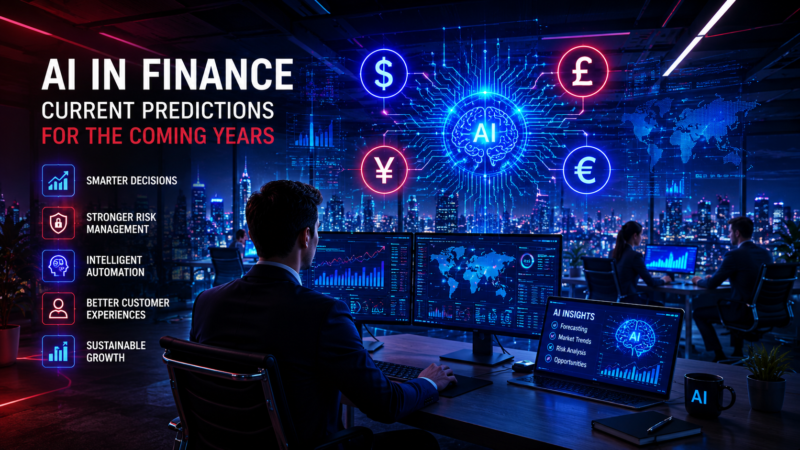
Just a short time ago, much of the discussion around AI in finance focused on automation fears, basic chatbots, and whether jobs might disappear. Today, the conversation has evolved significantly. Financial institutions are increasingly experimenting with AI agents, enhanced forecasting systems, fraud detection tools, governance frameworks, compliance monitoring, and more advanced forms of decision support.
The reality is simple.
No one can predict the future of Artificial Intelligence with complete certainty.
Technology moves quickly. Regulation changes. Customer expectations evolve. Markets adapt.
However, while exact predictions are impossible, it is possible to build a clearer understanding of where things may be heading and what finance professionals should be paying attention to.
That is one reason why we have recently completed another substantial review and update of our course:
📘 AI in Finance: Current Predictions for the Coming Years
Rather than treating AI as a fixed topic, we believe it makes far more sense to regularly revisit developments and ask:
What has changed?
What seems more likely now?
What assumptions may no longer hold?
Six Important Themes Shaping AI in Finance
During our latest course review, several important developments stood out.
1. AI Is Moving Beyond Experimentation
One of the biggest changes is that AI is increasingly moving from experimentation toward operational use.
Many financial organisations are no longer simply testing ideas.
AI is increasingly being used to support:
- forecasting
- fraud detection
- compliance monitoring
- reporting
- customer support
- internal productivity
The conversation is shifting from “Could this work?” to “How do we use this responsibly?”
2. AI Agents Are Emerging
Another important shift involves the rise of AI agents.
Unlike traditional tools that answer isolated questions, AI agents may increasingly support complete workflows.
For example, future finance systems may help professionals gather information, review performance, identify anomalies, generate draft reports, and highlight possible risks before a human expert makes a final decision.
This represents a significant shift in how financial work may evolve.
But importantly, accountability still remains human.
3. Governance and Explainability Matter More Than Ever
One of the clearest trends emerging across finance is the growing importance of governance.
Financial institutions cannot simply deploy powerful systems without oversight.
Questions increasingly matter such as:
- Can decisions be explained?
- Who remains accountable?
- How are errors monitored?
- What happens if systems drift or become unreliable?
AI capability alone is not enough.
Finance still depends on trust.
4. Customer Experience May Improve — But Not Equally
AI may make some financial services faster, more responsive, and easier to access.
Routine services may become smoother and more efficient.
However, our updated review also explores a more balanced reality.
Not every customer may benefit equally.
Those with straightforward financial situations may experience faster service, while more complex cases may still require strong human involvement and judgement.
This creates important questions around fairness, flexibility, and inclusion.
5. The Skills That Matter in Finance Are Changing
Another major theme emerging from our latest review is the changing nature of professional value.
The future of finance may increasingly reward professionals who combine financial expertise with:
- judgement
- communication
- governance awareness
- analytical scepticism
- adaptability
- AI understanding
Routine processing work may become less central over time.
Interpretation, explanation, and responsible decision making may become increasingly valuable.
6. Salary Expectations in Finance May Also Evolve
One issue increasingly sitting behind discussions about AI in finance is salary expectations and career value.
The reality is likely to be more nuanced than some headlines suggest.
Artificial Intelligence is unlikely to suddenly reduce salaries across the finance profession. Finance remains highly regulated, trust based, and dependent on human judgement. However, AI may gradually influence where value sits within financial organisations.
Routine, highly repetitive work may face greater pressure over time if AI allows organisations to complete certain tasks more efficiently. Some junior or processing focused roles may evolve as automation takes on more of the repetitive workload.
At the same time, other skills may become increasingly valuable.
Professionals who combine financial expertise with:
- judgement
- communication
- governance awareness
- commercial understanding
- analytical scepticism
- AI literacy
may increasingly position themselves more strongly for career progression and salary growth.
In simple terms, the future of finance may place less emphasis on repetitive preparation and more emphasis on interpretation, oversight, trust, and strategic decision making.
This does not mean finance careers become less attractive.
If anything, it may mean the profession increasingly rewards those able to adapt and work confidently alongside intelligent systems rather than compete against them.
Why the Future Looks More Collaborative Than Many Expected
Perhaps the biggest takeaway from our latest course review is this:
The future of finance does not currently look like a battle between people and machines.
It looks increasingly like collaboration.
AI appears most useful when supporting professionals rather than replacing them.
Finance remains a profession built on:
- trust
- accountability
- judgement
- explanation
These qualities remain difficult to automate.
Why We Review Our Courses Regularly
At AI Tuition Hub, we do not believe AI education should be written once and left unchanged.
Artificial Intelligence evolves too quickly for that.
As industries change, our aim is to revisit our courses, refresh assumptions, challenge outdated thinking, and help learners understand where developments appear to be moving.
Because while nobody can pinpoint the exact future of AI, staying informed about likely directions matters.
Especially in professions changing as quickly as finance.
If you want a deeper exploration of how AI may influence forecasting, compliance, customer service, governance, finance careers, wages, and the long term future of the profession, you can explore our updated course:
📘 AI in Finance: Current Predictions for the Coming Years
Because understanding AI is not simply about technology.
It is about understanding where professions themselves may be heading.
Updated June 2026.