AI is changing accountancy faster than many professionals expected.
At AI Tuition Hub, one of the ways we keep pace with this rapid change is through regularly reviewing how AI is evolving across professions and industries. Accountancy is one of the clearest examples of why this matters.
What felt cutting edge only a short time ago can quickly become standard practice.
AI is increasingly influencing bookkeeping, audit, forecasting, compliance monitoring, reporting, and even how accountants enter the profession. Large accounting firms are investing heavily in automation, analytics, and AI capability, while finance teams are increasingly expected to work alongside intelligent systems rather than rely solely on traditional manual processes.
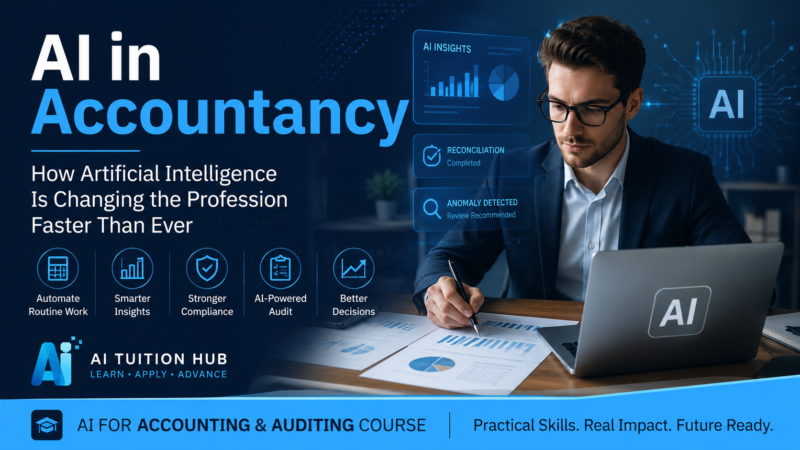
This is exactly why we recently refreshed elements of our AI for Accounting and Auditing course, ensuring it reflects the rapidly changing reality of modern finance environments.
Importantly, the conversation around AI in accountancy is no longer simply about efficiency.
It is increasingly about how the profession itself is evolving.
Big Accounting Firms Are Already Shifting
One of the strongest indicators of change comes directly from the profession itself.
Recent reporting has suggested that major firms including PwC, Deloitte, EY and KPMG are increasingly investing in AI capability and digital expertise, with growing demand for professionals who understand analytics, automation, governance, and intelligent systems alongside traditional accounting skills.
This matters because large accounting firms often signal where the wider profession may eventually head.
Historically, accountancy focused heavily on repetitive but important tasks.
Junior professionals often developed expertise through:
- reconciliations
- transaction reviews
- audit testing
- ledger checks
- spreadsheet analysis
These tasks helped build understanding of financial systems and professional judgement.
Today, many of these activities are increasingly automated.
AI powered systems can now help categorise transactions, reconcile balances, identify unusual activity, assist with forecasting, and support audit analytics at scale.
The profession is gradually moving from processing information toward understanding and interpreting it.
What Does This Mean for Future Accountants?
One of the most interesting developments in AI in accountancy concerns how professionals enter the field.
Traditionally, trainee accountants learned through repetition and practical exposure.
However, if intelligent systems increasingly complete routine tasks, early career pathways may naturally evolve.
Rather than spending most of their time processing transactions manually, future accountants may increasingly focus on:
- analysing exceptions
- reviewing automated outputs
- understanding financial patterns
- supporting governance frameworks
- interpreting risk indicators
This does not necessarily mean fewer opportunities.
It may simply mean different opportunities.
The future accountant may need stronger skills in:
- analytical thinking
- digital literacy
- governance awareness
- financial interpretation
alongside traditional accounting expertise.
Why Human Judgement Still Matters
Despite rapid progress, one thing remains clear.
AI does not replace professional judgement.
An intelligent system may identify unusual activity, but it cannot fully understand business context, reputational concerns, ethical implications, or strategic intent.
A professional accountant still determines:
- whether unusual activity represents genuine risk
- whether forecasts remain realistic
- whether reporting reflects economic reality
- whether financial treatment remains appropriate
In many ways, human judgement may become more important, not less.
AI strengthens capability.
Professionals provide interpretation and accountability.
The Bigger Picture
The pace of change in AI in accountancy is accelerating.
That is why regular professional review matters.
At AI Tuition Hub, we continue monitoring how AI is reshaping industries so our training reflects current professional realities rather than outdated assumptions.
Accountancy is evolving.
The repetitive administrative side of the profession may continue to reduce, while interpretation, governance, advisory capability, and strategic insight become increasingly important.
The accountants who thrive are unlikely to be those resisting change.
They are more likely to be the professionals who understand how to work confidently and responsibly alongside intelligent systems.
The future of accountancy may look different from the past.
But it may also become more analytical, more strategic, and more influential than ever before.
Updated June 2026.