AI Is Quietly Replacing Marketing Jobs, and many people may not even realise how quickly the profession is changing. Marketing used to be seen as one of the safer creative professions. Human imagination, communication, storytelling and customer understanding were thought to be difficult for machines to replicate. But in 2026, something significant is happening in workplaces around the world. Artificial Intelligence is quietly transforming marketing departments, automating routine work, and changing the skills businesses now value.
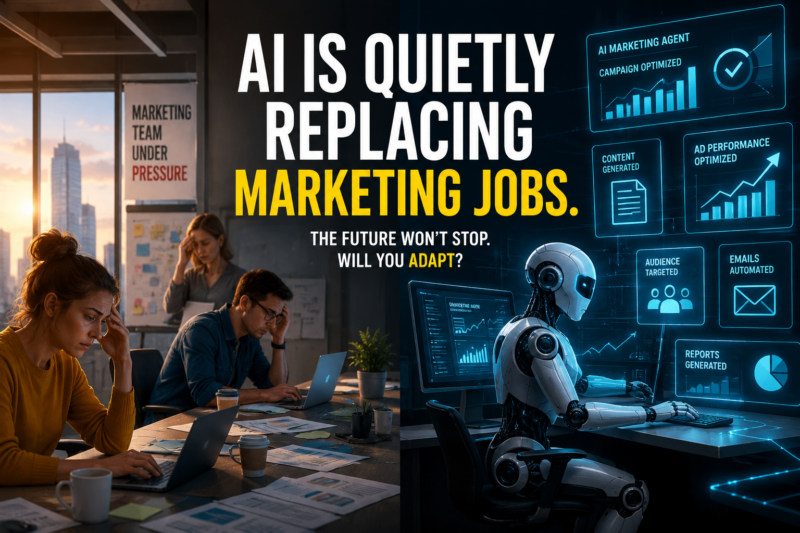
Many people still think of AI as simply helping marketers write social media posts or improve advertisements. However, the latest developments suggest something much bigger is taking place. AI is increasingly moving beyond assistance and into execution. In other words, AI is no longer just helping marketers work faster. In many cases, it is beginning to carry out the work itself.
A recent industry report highlighted the growing number of AI powered marketing platforms now entering the market, with software capable of automating customer targeting, analysing data, creating campaigns, testing advertisements and even making decisions in real time. You can read the original story here.
What Is Happening to Marketing Jobs?
The reality is that marketing has always involved a mix of creative thinking and repetitive administrative work. While humans may still lead on strategy and brand direction, many day to day marketing tasks are increasingly being automated.
AI tools are now capable of:
- Writing first drafts of blog posts and marketing emails
- Creating social media captions and content ideas
- Analysing customer behaviour patterns
- Running advertising tests automatically
- Monitoring website performance and SEO
- Segmenting audiences for personalised campaigns
- Producing reports in minutes instead of hours
Only a few years ago, many of these tasks were handled by junior marketing staff, assistants, or outsourced agencies. Today, one skilled employee equipped with AI tools can often complete work that previously required several people.
This does not necessarily mean marketing jobs will disappear overnight. However, it does suggest that AI marketing jobs are changing faster than many workers expected.
The Rise of AI Marketing Agents
Perhaps the biggest shift is the rise of what many companies are calling AI agents.
Unlike traditional software, which simply follows instructions, AI agents can often carry out entire workflows independently. They can analyse information, make decisions based on patterns, and adjust campaigns automatically.
For example, imagine an online retailer launching a summer sale. Instead of a marketing team manually testing adverts, analysing click rates and adjusting budgets over several weeks, AI can increasingly do this in real time.
The software may:
- Decide which advert performs best
- Adjust spending automatically
- Personalise messaging to customers
- Predict which products are likely to sell
- Send targeted promotions instantly
This level of automation is already beginning to reshape marketing departments.
For businesses, this may improve efficiency and reduce costs. But for workers, particularly those entering the profession, it raises an important question: where will future entry level opportunities come from?
Are Entry Level Marketing Jobs at Risk?
This is perhaps the most uncomfortable conversation surrounding AI.
Traditionally, junior marketing roles allowed people to learn the basics of campaigns, customer engagement, analytics and content creation. Many graduates started by carrying out repetitive tasks before gradually moving into more senior strategic roles.
The challenge today is that AI increasingly performs many of these entry level responsibilities.
If businesses can automate content drafting, reporting, audience segmentation and campaign testing, fewer junior staff may be required.
We are already seeing signs of this across industries. Employers are increasingly advertising for people who can supervise AI tools rather than perform repetitive manual tasks themselves.
That does not mean all opportunities will disappear. Instead, the skills employers look for may evolve significantly.
What Skills Will Matter More in the AI Era?
As AI becomes more powerful, the most valuable workers are likely to be those who understand how to work alongside technology rather than compete directly against it.
In marketing, future skills may increasingly include:
AI supervision
Knowing how to guide, review and quality check AI generated content rather than simply creating everything manually.
Strategic thinking
Businesses will still need people who understand customers, branding, reputation and long term planning.
Data interpretation
AI may generate reports instantly, but humans still need to interpret results and make sensible business decisions.
Ethics and governance
As AI becomes more powerful, companies will need people to ensure content remains accurate, fair and compliant with regulations.
Human creativity
Despite advances in AI, genuinely original ideas, emotional storytelling and authentic communication still matter.
In reality, marketing may not disappear. Instead, it may become smaller, faster and far more technology driven.
Why This Matters Beyond Marketing
The bigger story here is not just about marketing.
What is happening in marketing today may be a warning sign for many other industries tomorrow.
Finance, administration, customer service, retail, legal services and even healthcare are all beginning to experience similar changes. Repetitive tasks are increasingly being automated, while workers are expected to supervise systems, interpret data and focus on higher value activities.
For years, automation mainly affected manual labour and manufacturing jobs. AI is different because it increasingly affects office based professions too.
That is why discussions about AI marketing jobs matter. They provide a glimpse into what many workplaces may look like over the next decade.
Final Thoughts
AI is quietly reshaping the marketing profession, whether businesses openly discuss it or not.
For some organisations, this will mean lower costs and faster results. For workers, it may mean adapting to a world where repetitive tasks are increasingly handled by intelligent systems.
The key message is not panic. It is preparation.
Workers who understand AI, learn how to use it effectively, and develop skills that complement automation may still thrive in the years ahead.
The question is no longer whether AI will change marketing.
The question is: how quickly will workers adapt?
The reality is that AI marketing jobs are changing quickly, and workers who adapt early may have the strongest long term opportunities.
At AI Tuition Hub, we help people understand practical workplace AI skills through more than 100 career focused courses covering AI, automation, productivity and the future of work.