Artificial intelligence is moving faster than many people expected. Across workplaces, schools, offices and industries, AI tools are beginning to influence how people write, research, analyse information and complete everyday tasks. What once felt futuristic is now becoming increasingly normal. From workplace assistants capable of drafting reports to systems that summarise meetings and analyse large volumes of information in seconds, AI is moving rapidly into everyday life.
For some people, this feels exciting. For others, it feels deeply uncertain.
That uncertainty may now be growing into something much bigger.
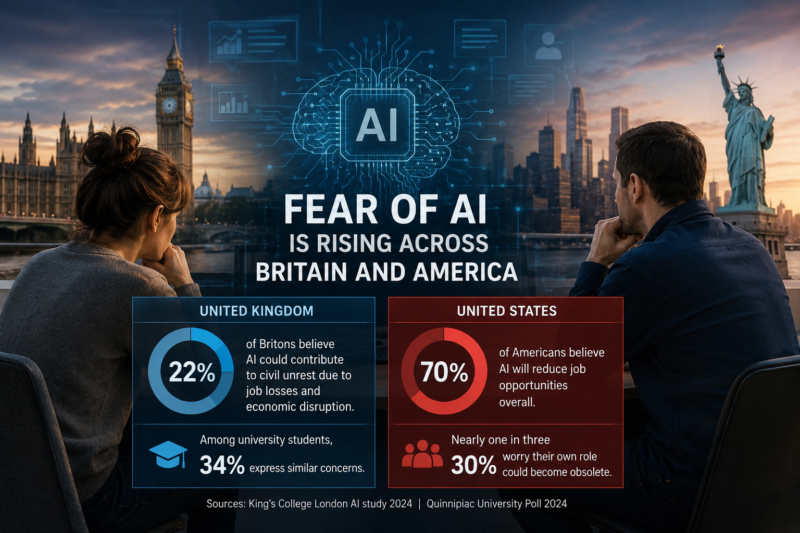
A recent study by King’s College London found that around one in five Britons believe artificial intelligence could eventually contribute to civil unrest because of job losses and wider economic disruption. Among university students, concern appeared even stronger, with around a third expressing similar worries about the future impact of AI on society and employment. King’s College London study on AI concerns
Meanwhile, concern is not limited to Britain. In the United States, recent polling found that 70 percent of Americans believe artificial intelligence will reduce job opportunities overall, while almost one in three worry their own role could eventually become obsolete because of AI. Quinnipiac University polling on AI and jobs
Taken together, these findings reveal something important. Fear of AI is rising across Britain and America, and increasingly ordinary workers are beginning to ask difficult questions about what this technology may mean for jobs, careers and economic stability.
Should workers genuinely be worried? Or are we witnessing the kind of anxiety that often accompanies every major technological shift?
The answer probably sits somewhere in the middle.
Why Fear of AI Is Rising Across Britain and America
For years, artificial intelligence felt distant. It was often discussed as something futuristic, highly technical or relevant only to major technology companies. Most people could comfortably ignore it because it seemed unlikely to affect their own career anytime soon.
That has changed quickly.
Today, AI can already assist with writing, research, customer support, administration, data analysis, translation, presentations and coding. In many workplaces, employees are beginning to encounter AI systems whether they actively seek them out or not.
Email software increasingly suggests responses. Meetings can be automatically summarised. Customer enquiries are being handled by intelligent systems. Reports can be drafted in seconds. Administrative tasks that once took hours may now take minutes.
Suddenly, artificial intelligence no longer feels theoretical.
It feels personal.
A graduate entering the workplace may wonder whether entry level jobs will still exist in the same way. An administrator may ask how much of their workload could eventually become automated. A finance professional may question whether reporting tasks will change significantly over time.
These concerns are understandable.
Most fears about AI are not really fears about technology itself. They are fears about stability, security and opportunity. People worry about earning a living, supporting families and whether younger generations will still have clear career pathways.
In many ways, concern about artificial intelligence is really concern about economic confidence.
What the UK Research Actually Found
The recent King’s College London findings attracted attention because they suggested public concern may be becoming more serious.
According to the research, around 22 percent of Britons believe artificial intelligence could contribute to civil unrest due to job losses and economic disruption. Among university students, concern reportedly rose to around 34 percent.
At first glance, civil unrest sounds dramatic. Britain has experienced significant technological shifts before without widespread social breakdown.
But the concern itself matters.
It suggests many people believe artificial intelligence may create disruption faster than society is prepared to handle. Whether those fears eventually prove justified is another question entirely, but public confidence still matters.
History tells us that when people begin to feel left behind economically, frustration tends to rise.
We have seen this during previous periods of industrial change. Communities affected by factory closures often struggled for decades. Entire sectors have been reshaped by technology before. Jobs evolve, disappear or transform, and not everybody benefits equally.
Artificial intelligence may represent another major period of transition.
The difference is speed.
Many workers feel as though change is happening unusually quickly, leaving little time to adjust.
That perception matters because uncertainty itself can influence behaviour. If people become convinced they are losing control of their economic future, anxiety naturally increases.
Why Americans Are Worried Too
The growing concern surrounding artificial intelligence is not unique to Britain.
Across the United States, anxiety around AI and jobs appears to be growing too.
Recent polling suggested around 70 percent of Americans believe AI will reduce job opportunities overall, while nearly one in three believe their own role could eventually become obsolete.
That is significant.
The United States has traditionally been one of the world’s most technology optimistic countries. Historically, Americans have often embraced innovation more enthusiastically than many nations.
Yet even there, concern is growing.
Why?
Because artificial intelligence feels different from previous technological advances.
Computers improved productivity. The internet transformed communication. Software improved efficiency.
AI, however, appears capable of handling elements of intellectual work itself.
This creates uncertainty for both manual and office based professions.
In the past, many white collar workers assumed their jobs were relatively protected from automation. Now administrators, analysts, marketers, accountants, customer service teams and even some legal professionals are beginning to wonder how artificial intelligence may reshape aspects of their work.
This does not necessarily mean jobs vanish.
But it does mean many roles could evolve significantly.
Why Younger Workers May Feel Most Vulnerable
One particularly interesting aspect of the UK findings was the stronger concern among younger adults and university students.
This is understandable.
Historically, careers often developed through gradual experience. Junior employees entered workplaces and slowly built skills through repetition, administration, research and support work.
Many people learned by doing.
Junior analysts reviewed documents. Graduates carried out research. Administrators organised workflows. Over time, professional confidence developed.
But many of these tasks happen to be areas where artificial intelligence performs surprisingly well.
AI can summarise information, draft content, analyse trends and process large volumes of material quickly.
This raises an uncomfortable question.
If entry level work increasingly becomes automated, how do younger workers gain experience?
It is likely to become one of the biggest workplace questions of the coming decade.
At the same time, there may also be opportunity.
Younger professionals who understand AI may actually place themselves at an advantage. Rather than competing against artificial intelligence, they may learn how to supervise it, challenge it and combine it with human judgement.
In many ways, AI literacy may become as normal as digital literacy once became.
A generation ago, understanding spreadsheets, email and workplace software became essential. Tomorrow, understanding how to work effectively with artificial intelligence may simply become another expected skill.
Are We Already Seeing Signs of Change?
In some sectors, early signs of workplace transformation are already emerging.
Businesses increasingly discuss productivity, efficiency and cost reduction. Repetitive and routine tasks are often the first areas where automation begins to appear.
Administrative support, scheduling, drafting, customer service and basic information processing are becoming easier to automate or partially automate.
Some employers may eventually hire differently.
Others may redesign roles completely.
Certain entry level positions may shrink while new positions emerge that barely existed a few years ago.
Already, there is growing interest in roles involving AI oversight, prompt writing, automation workflows and productivity improvement.
But it is important not to overstate what is happening.
Most organisations are still experimenting.
Many businesses remain cautious.
Artificial intelligence is powerful, but it still makes mistakes. Human oversight remains extremely important.
Workers are not suddenly disappearing overnight.
Instead, workplaces appear to be evolving gradually.
That distinction matters.
Could AI Really Replace Jobs?
This is where discussions about artificial intelligence often become polarised.
Some believe widespread unemployment is inevitable.
Others argue fears are exaggerated and little will change.
Reality will probably sit somewhere between the two extremes.
Yes, some jobs may shrink.
Yes, certain tasks will likely become increasingly automated.
Yes, productivity gains may reduce demand for some forms of routine work.
But history also suggests that new technologies create new opportunities.
Jobs evolve.
Entirely new industries appear.
Skills change.
Work rarely stands still.
In practice, many jobs may simply shift rather than disappear.
An administrator may spend less time formatting documents and more time reviewing outputs.
An analyst may spend less time gathering information and more time interpreting it.
A customer service professional may supervise intelligent systems rather than answering every enquiry directly.
The most valuable workers of the future may not necessarily be those competing against AI.
Instead, they may be the people who understand how to work alongside it effectively.
Why Human Skills Still Matter
One reason predictions about AI sometimes become exaggerated is because they underestimate human strengths.
Artificial intelligence can process information quickly.
But workplaces depend on far more than information processing.
Judgement matters.
Communication matters.
Trust matters.
Leadership matters.
Empathy matters.
Creativity matters.
AI may generate suggestions, but people still decide what is appropriate. Human oversight remains critical, particularly in industries involving ethics, risk, compliance or complex decision making.
This is especially relevant in professional environments where accuracy and accountability matter.
Artificial intelligence can assist.
But responsibility still tends to remain with people.
Why Fear Alone Is Not a Strategy
If one in five Britons genuinely believe artificial intelligence could eventually contribute to social unrest, it tells us something important.
People want reassurance.
More importantly, they want clarity.
Fear alone changes very little.
Ignoring artificial intelligence will not stop workplace change from happening. Equally, panic rarely produces useful decisions.
The more practical approach may be preparation.
That does not mean everybody suddenly needs to become a programmer or data scientist.
For most people, adapting may simply mean understanding how AI works, recognising its strengths and weaknesses and learning where it can genuinely improve productivity.
Practical knowledge matters.
The workplace is changing whether people feel ready or not.
Final Thoughts
Fear of AI is rising across Britain and America, and the concerns are understandable. Workers are asking difficult questions about jobs, stability and opportunity. Younger people in particular appear increasingly uncertain about how careers may evolve in an AI driven economy.
At the same time, history suggests technological change rarely follows the most extreme predictions.
Yes, disruption is likely.
Yes, some jobs will evolve significantly.
But panic is unlikely to be the answer.
Preparation probably matters far more.
Learning about artificial intelligence does not mean becoming a technical expert. For most people, it simply means understanding how workplace expectations are changing and learning how to work effectively alongside new tools.
At AI Tuition Hub, we believe practical understanding matters. With over 100 workplace focused AI courses available for £19.95 per month, access works out at less than 20p per course. The goal is simple: helping people build practical AI knowledge in a balanced and realistic way as the workplace continues to evolve.
Because while fear of AI may be rising, confidence often starts with understanding.