Artificial Intelligence in the office is often reduced to one thing: ChatGPT.
While tools like ChatGPT have made AI more visible, they only represent a small part of what is actually happening in modern workplaces. The reality is that AI in the office is transforming how work flows, how teams operate, and how decisions are made across organisations.
AI is no longer just about generating text. It is now embedded into everyday systems that support workflows, meetings, documents, planning, and leadership.
AI in the Office Is More Than a Chatbot
When people think about AI in the office, they often think about drafting emails or generating content. While useful, this is only the surface level.
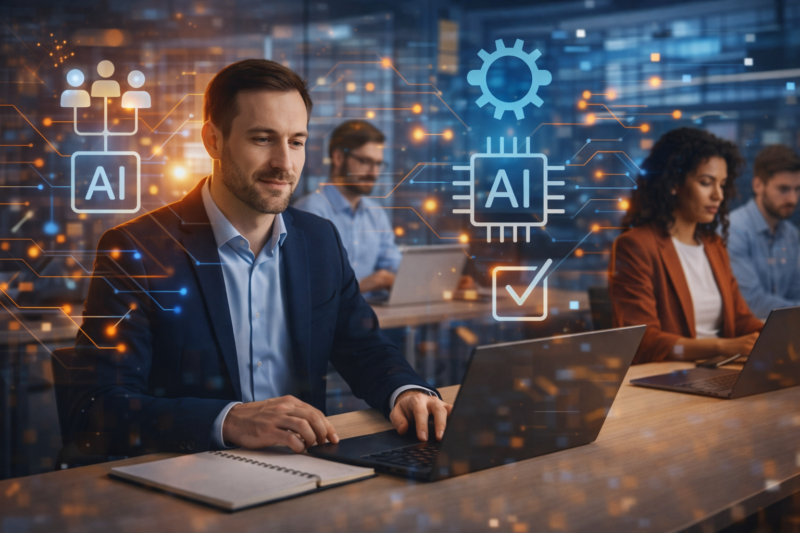
In practice, AI in the office now supports:
- Workflow coordination across systems
- Meeting management and follow up
- Document organisation and reporting
- Time planning and scheduling
- Team insight and workload balance
This shift moves AI away from being a standalone tool and into something far more valuable. It becomes part of the infrastructure that supports how work gets done.
How AI Is Changing Everyday Office Work
Office work is built on systems rather than isolated tasks. A single piece of work often involves communication, approvals, documentation, and coordination across teams.
AI improves these systems by:
- Reducing delays between workflow stages
- Identifying bottlenecks and inefficiencies
- Improving communication clarity
- Supporting real time meeting summaries and action tracking
- Allowing users to interact with documents using natural language
- Helping teams plan workloads more effectively
These improvements are where the real gains are being made.
What This Means for Office Managers and Team Leaders
For office managers and team leaders, AI in the office is not about replacing responsibility. It is about improving visibility.
Instead of relying on guesswork, leaders can see:
- Where work is slowing down
- Where teams are overloaded
- Where communication is unclear
- Where processes need improvement
This allows earlier intervention and better decision making.
Leadership shifts from chasing updates to improving systems and supporting people more effectively.
Why Better Systems Matter More Than Ever
Modern office environments are more complex than ever. Hybrid work, global teams, and constant digital communication create pressure on time, attention, and coordination.
AI helps restore structure to this complexity.
It does not remove human responsibility. It strengthens it by making work more predictable, visible, and manageable.
When used properly, AI reduces stress, improves clarity, and supports more sustainable ways of working.
Explore AI in the Office Courses
If you want to understand how AI in the office is actually applied in real working environments, rather than just how to use a chatbot, AI Tuition Hub covers this in depth.
Courses such as:
- AI in Office and Administrative Work
- AI for Office Managers and Team Leaders
focus on how AI supports workflows, meetings, document systems, time planning, and team insight.
These are part of a wider library of more than 100 courses designed to show how AI is used in real world roles and industries.
You can explore the full course list here:
AI Tuition Hub – All Courses
AI in the Office Is About Systems, Not Just Tools
The key takeaway is simple.
AI in the office is not about asking better questions. It is about building better systems.
Organisations that understand this will improve efficiency, reduce friction, and support their teams more effectively.
Those that focus only on tools will miss the bigger opportunity.
Final Thought
AI in the office is already reshaping how work happens behind the scenes.
The biggest changes are not always the most visible, but they are the ones that matter most.
Better workflows, clearer communication, improved planning, and stronger leadership all come from using AI to support systems rather than replace people.