Across industries such as finance, logistics, marketing, healthcare, retail, and manufacturing, organisations are beginning to integrate AI into everyday operations. The result is a significant shift in how businesses analyse information, manage workflows, serve customers, and make strategic decisions.
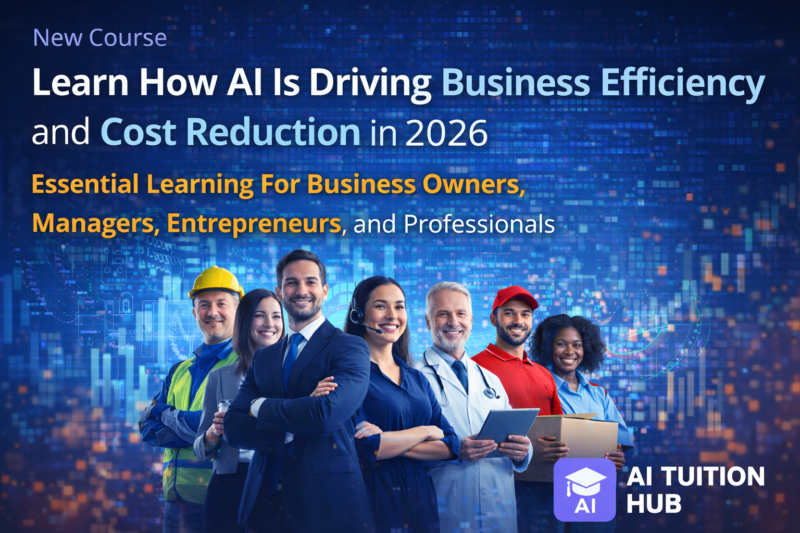
At AI Tuition Hub, we have launched a new course designed to explore this transformation in depth.
💰 AI for Business Efficiency and Cost Reduction (2026) examines how organisations are currently using artificial intelligence to streamline operations, automate workflows, and improve productivity across a wide range of industries.
Why AI for Business Efficiency Is Growing
Companies are under constant pressure to improve efficiency while managing costs. Labour expenses, administrative workloads, operational complexity, and rising customer expectations all place increasing demands on organisations.
Artificial intelligence offers a practical way to address these challenges.
AI systems can analyse large volumes of data in seconds, automate repetitive processes, identify patterns in complex information, and assist employees with decision making. Rather than replacing human workers, many organisations are using AI as a tool that supports employees and allows them to focus on higher value tasks.
Businesses are increasingly using AI to:
analyse financial transactions and detect anomalies
automate customer support responses
generate marketing content and analyse campaign performance
forecast demand and manage inventory
streamline recruitment and employee onboarding
analyse customer feedback and behaviour patterns
These capabilities allow organisations to operate more efficiently while maintaining service quality.
AI Is Appearing Across Every Business Function
One of the most important developments in recent years is that AI is no longer limited to technology companies. Businesses across nearly every sector are exploring how artificial intelligence can support their operations.
Marketing teams are using AI tools to analyse audience behaviour and assist with campaign planning.
Finance departments are using AI supported analytics to monitor transactions, identify financial risks, and improve forecasting.
Customer service teams are deploying AI supported systems that provide faster responses to routine enquiries.
Supply chain managers are using predictive models to anticipate demand changes and manage inventory more efficiently.
Even smaller businesses and entrepreneurs now have access to AI tools that were previously available only to large corporations.
As AI platforms become more accessible and easier to use, adoption is accelerating across organisations of all sizes.
Understanding the Opportunities and the Risks
While AI offers significant advantages, businesses must also approach its adoption thoughtfully.
Automating processes can improve productivity, but it can also introduce challenges. Poorly implemented AI systems may frustrate customers, generate inaccurate outputs, or create ethical concerns if data is used incorrectly.
Many organisations are discovering that the most effective approach combines AI capabilities with human oversight.
AI systems can process information quickly and identify patterns, while human professionals provide judgement, creativity, and contextual understanding.
Understanding how to strike this balance is an important part of responsible AI adoption.
What This Course Covers
The course provides a comprehensive overview of how AI is currently influencing business operations.
Throughout the lessons, learners explore how artificial intelligence is being used to support efficiency across many areas of business activity.
Topics covered include:
how AI is reducing administrative workloads
how marketing teams use AI for research and content creation
how AI supports financial analysis and forecasting
how AI improves logistics and supply chain coordination
how AI assists recruitment and human resources processes
how businesses are building AI supported workflows
how customer expectations are changing as AI driven services become more common
how organisations can adopt AI responsibly and ethically
The course also examines investment trends in artificial intelligence and the direction in which AI driven business efficiency appears to be developing across industries.
Who This Course Is Designed For
This course is designed for anyone who wants to understand how artificial intelligence is influencing modern business operations.
It may be particularly useful for:
business owners interested in improving efficiency
managers exploring digital transformation strategies
entrepreneurs building modern AI supported companies
professionals who want to stay informed about AI adoption
students studying business technology and innovation
No technical or programming background is required. The course focuses on practical understanding rather than complex technical theory.
The Growing Importance of AI Literacy in Business
Just as digital literacy became essential during the rise of the internet, AI literacy is becoming increasingly important across business environments.
Understanding how AI tools work, where they can create value, and where human oversight remains essential will increasingly shape how organisations make decisions, manage costs, and improve productivity.
Businesses that understand how to integrate AI thoughtfully are more likely to strengthen efficiency, improve customer experience, and remain competitive in a rapidly changing environment.
Explore AI Tuition Hub
💰 AI for Business Efficiency and Cost Reduction (2026) is now available on AI Tuition Hub.
The course provides a practical exploration of how artificial intelligence is reshaping modern organisations and helping businesses improve efficiency across many industries.
To explore the course and the full library of AI training available, visit: All Courses.