Introduction
AI in education is rapidly reshaping how schools, universities, and training organisations operate. From classroom learning tools and personalised study support to administrative automation and national education strategy, AI technologies are beginning to influence how education systems operate across the world.
The Growing Role of AI in Education
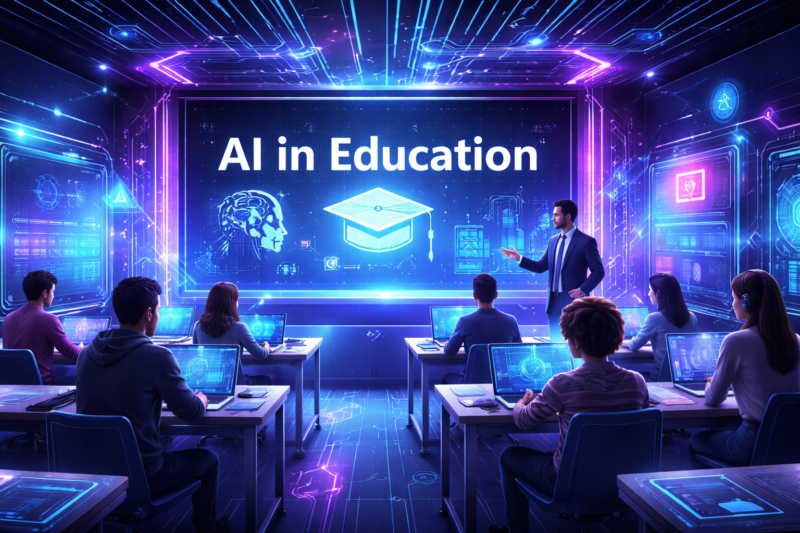
Schools, universities, and training organisations are exploring how AI can improve learning outcomes, support educators, streamline administration, and prepare students for a technology driven economy. At the same time, governments are increasingly recognising that education will play a central role in global competition for AI talent and innovation.
Understanding how AI affects education therefore requires looking at several dimensions at once: teaching and learning technologies, institutional management, student skills, and the strategic role of education in national AI development.
AI Leadership and Global Competition in Education
Artificial intelligence is becoming a strategic priority for many countries. Governments increasingly view education systems as the foundation for developing AI expertise, research capability, and digital innovation.
Universities are expanding programmes in data science, machine learning, and AI engineering. Schools are beginning to introduce computational thinking, digital literacy, and AI awareness into curricula. Public policy discussions are also focusing on how education systems can adapt quickly enough to prepare students for a future shaped by automation and intelligent technologies.
Education therefore sits at the centre of global technological competition. Nations that develop strong AI education ecosystems are more likely to produce skilled professionals, attract investment, and lead in emerging industries.
This broader context is explored in the course AI Leadership and Global Competition: Education at the Frontier, which examines how education policy, research institutions, and national strategy intersect with AI development.
AI in Educational Administration and Student Management
While much attention focuses on classroom technology, AI is also transforming how educational institutions operate behind the scenes.
Administrative tasks such as admissions processing, student support systems, timetable planning, resource allocation, and performance monitoring generate vast amounts of data. AI tools can analyse this data to help institutions identify trends, improve planning, and respond more effectively to student needs.
For example, AI driven analytics may help universities identify students at risk of dropping out, allowing support services to intervene earlier. Automated systems can assist with scheduling, digital record management, and personalised communication with students.
These technologies do not replace administrators or educators. Instead, they support decision making and allow staff to focus more time on student engagement and educational quality.
The course AI for Educational Administration and Student Management explores how AI tools support institutional operations and student services.
AI in Education and Learning Technologies
The most visible impact of AI in education is occurring within the learning environment itself.
AI powered learning platforms can adapt content to individual students, adjusting the pace and difficulty of material based on progress and understanding. Intelligent tutoring systems can provide feedback, explain concepts, and recommend further resources when learners struggle with particular topics.
AI is also integrated into tools such as automated transcription, translation systems, accessibility support, and digital classroom platforms. These technologies help make learning materials more accessible to students from diverse linguistic and educational backgrounds.
Teachers increasingly use AI to assist with lesson planning, content generation, and assessment support. Used carefully, these tools can help educators focus more on mentoring, discussion, and critical thinking rather than routine administrative tasks.
These developments are examined in the course AI in Education and Learning Technologies, which explains how AI systems support modern learning environments.
AI for Students: Smarter Study, Research, and Career Skills
AI is also changing how students approach learning itself.
Students now have access to AI powered research tools, summarisation systems, translation tools, writing assistants, and data analysis platforms. These technologies can help learners explore complex topics, organise information more efficiently, and develop stronger analytical skills.
However, using AI responsibly is just as important as learning how to use it effectively. Students must understand issues such as academic integrity, verification of AI generated information, and the limits of automated tools.
Developing responsible AI literacy is therefore becoming an important part of modern education. Students who understand how to work alongside AI tools will likely be better prepared for careers in fields where automation and data driven decision making are increasingly common.
These themes are explored in the course AI for Students — Smarter Study, Research, and Career Skills, which focuses on practical ways students can use AI tools responsibly.
The Future of Education in the AI Era
Artificial intelligence will not replace education. Instead, it will reshape how education is delivered, managed, and experienced.
Teachers will continue to play a central role in guiding critical thinking, creativity, and ethical reasoning. Educational institutions will continue to provide structure, mentorship, and intellectual community. AI technologies will act as tools that support these human foundations.
The most successful education systems will likely be those that combine technological innovation with strong teaching practices and responsible governance.
Understanding how AI influences education is therefore essential for educators, administrators, policymakers, and students alike.
Explore AI Education Courses
If you would like to explore these topics in more depth, you can browse the full range of AI education courses available on AI Tuition Hub.