AI translation is quietly transforming how people communicate across languages. What once required specialist translators, long delays, and significant cost can now be supported instantly through AI powered systems embedded directly into everyday digital tools.
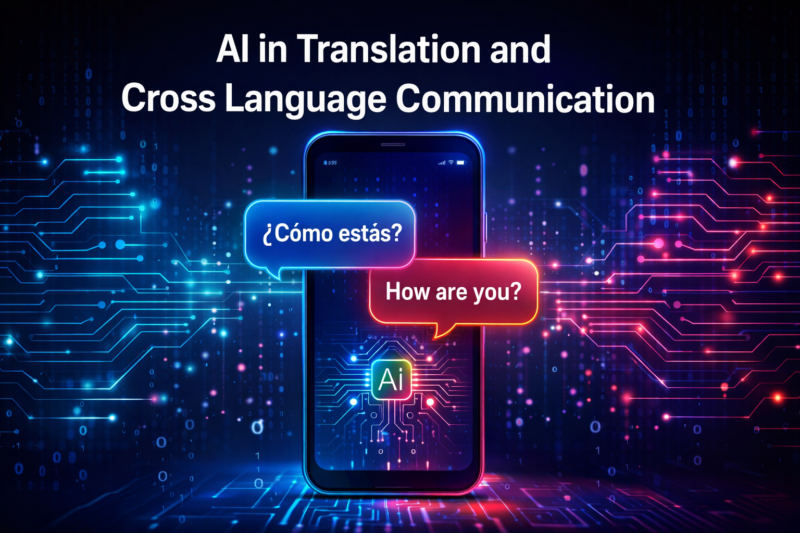
Featured Course: AI in Translation and Cross Language Communication
Modern workplaces increasingly operate across borders. Teams collaborate across continents, customers contact companies from multiple countries, and educational institutions serve students from a wide range of linguistic backgrounds. In this environment, multilingual communication has become a practical requirement rather than a specialist activity.
AI translation tools are now integrated into email platforms, messaging systems, document software, video conferencing platforms, and customer support systems. These tools allow users to translate text, generate subtitles, summarise multilingual conversations, and assist communication in real time.
The result is a world in which language barriers are becoming less restrictive than at any point in history.
From Machine Translation to AI Driven Language Systems
Early machine translation systems relied on fixed grammar rules and simple word substitution. These approaches struggled to capture nuance, tone, and sentence structure. Translations were often rigid and inaccurate.
Modern AI translation systems operate very differently.
Today’s platforms use neural networks and large language models trained on enormous multilingual datasets. These models analyse patterns in language and generate translations that aim to preserve meaning, grammar, and context.
Rather than translating word by word, AI evaluates relationships between words, sentence structure, and surrounding context. This approach produces translations that are significantly more natural than earlier systems.
Many tools also combine translation with additional capabilities such as summarisation, transcription, voice generation, and multilingual content creation.
Real Time Multilingual Communication
One of the most significant developments is the rise of real time translation.
Video conferencing platforms now support live captions and translated subtitles. Messaging systems can automatically translate incoming messages. Customer service tools can detect a customer’s language and generate translated responses for support teams.
In many situations, participants in a meeting can speak their native language while reading translated captions from others in real time.
This does not eliminate the need for human interpreters in sensitive environments, but it dramatically expands the ability of organisations to collaborate internationally.
AI Translation in Everyday Work
AI translation now supports many professional activities, including:
Translating emails and documents
Supporting international customer service
Generating subtitles for meetings and presentations
Helping teams collaborate across borders
Localising websites and digital products
Supporting multilingual education environments
These tools allow organisations to communicate faster while expanding access to global markets and audiences.
Human Judgement Still Matters
Despite rapid progress, AI translation systems do not truly understand culture or emotion. They recognise patterns in language but lack lived experience and social awareness.
This means certain types of communication still require human expertise.
Legal contracts, medical information, diplomatic communication, and emotionally sensitive conversations demand careful interpretation and cultural awareness. In these contexts, professional translators remain essential.
The most effective approach is a partnership model in which AI accelerates routine translation while humans review content where nuance and responsibility are required.
Learning How AI Translation Works
Understanding how AI translation systems function helps professionals use them responsibly.
It allows organisations to recognise where these tools are most effective, where limitations remain, and how workflows can combine speed with quality oversight.
AI Tuition Hub recently introduced a course exploring these topics in depth. The course examines (Course Page) how neural translation systems work, how real time multilingual communication is evolving, and how organisations can design responsible cross language workflows.
Rather than focusing on speculation, the course explains how AI translation is already being used in workplaces, education, public services, and digital collaboration environments.
A More Connected World
AI translation is not eliminating language differences, but it is making communication across those differences significantly easier.
By reducing barriers between languages, these systems allow people from different regions, cultures, and backgrounds to collaborate more effectively.
As the technology continues to improve, AI supported multilingual communication is likely to become a normal feature of everyday work around the world.
Understanding how these systems function today helps professionals prepare for a future in which global communication is increasingly immediate, accessible, and collaborative.