AI in Education in 2026 is no longer experimental. Artificial intelligence is now embedded in classrooms, homework platforms, revision tools and grading systems. It is now embedded in classrooms, homework platforms, revision tools, and even grading systems. In 2026, AI in education is not experimental. It is operational.
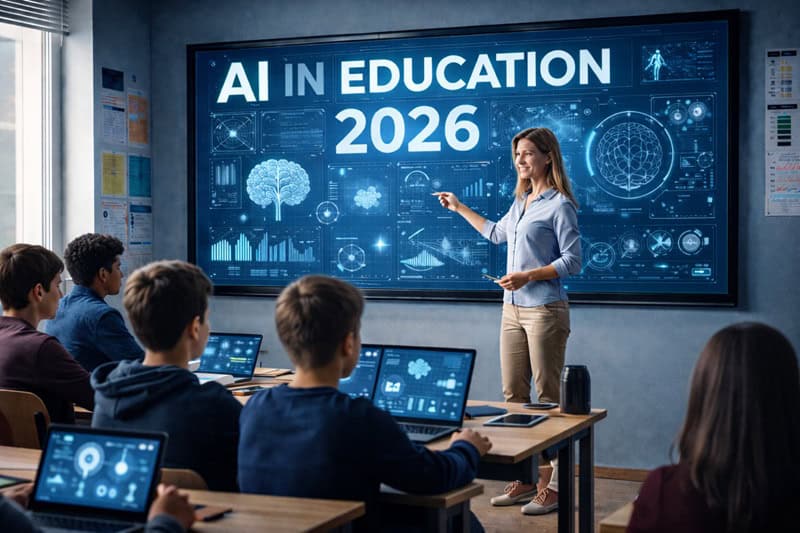
But while the tools are advancing quickly, understanding is not always keeping pace.
For schools, teachers and parents, the key question is no longer whether AI will enter education. It is how it should be used responsibly, safely and effectively.
How AI Is Already Changing the Classroom
AI tools are being used across multiple areas of education:
- Personalised learning platforms that adapt to student performance
- AI tutors that provide instant feedback
- Automated marking systems
- Writing assistants
- Language translation tools
- Administrative workflow automation
These systems can increase efficiency and, in some cases, improve engagement. Students can receive faster feedback. Teachers can reduce time spent on repetitive marking. Schools can streamline administrative tasks.
However, increased capability does not automatically mean better outcomes.
AI in Education in 2026: The Rise of AI Assisted Homework
One of the most visible changes is the use of generative AI for homework support. Students are increasingly turning to AI systems to:
- Draft essays
- Solve maths problems
- Summarise texts
- Generate revision notes
- Translate materials
This raises important questions.
When does assistance become dependency?
How should schools differentiate between learning support and academic misconduct?
What skills risk being underdeveloped?
Many educational institutions are now rewriting academic integrity policies to address AI usage explicitly.
Personalised Learning: Opportunity and Risk
AI driven adaptive learning platforms promise to tailor content to each student’s pace and performance. In theory, this reduces the one size fits all model of traditional teaching.
Potential benefits include:
- Early identification of learning gaps
- More targeted practice
- Increased student confidence
- Flexible pacing
But risks include:
- Over reliance on automated systems
- Reduced human interaction
- Data privacy concerns
- Algorithmic bias
The human element of teaching remains critical. AI can support instruction, but it cannot replace mentorship, emotional intelligence and classroom leadership.
Teacher Workload and Automation
AI also affects teachers directly.
Administrative burden is a significant issue in many education systems. AI tools that assist with:
- Lesson planning
- Marking
- Report drafting
- Attendance tracking
can reduce workload pressure.
However, professional judgement remains essential. AI generated feedback still requires human review. Automated marking systems may struggle with nuance, creativity and context.
The goal is augmentation, not replacement.
Digital Safety and AI Literacy
Perhaps the most urgent issue is AI literacy.
Students are interacting with powerful AI systems, often without fully understanding:
- How they work
- Their limitations
- The risk of misinformation
- The potential for bias
- Data privacy implications
Without structured AI education, students may:
- Accept outputs uncritically
- Share personal information unknowingly
- Become overly dependent on automated tools
AI literacy should now be considered a core digital skill alongside online safety, cybersecurity awareness and media literacy.
The Parent Perspective
For parents, AI can feel both promising and unsettling.
On one hand, AI tools can help children revise more effectively and access explanations instantly. On the other, parents worry about:
- Cheating
- Reduced critical thinking
- Screen time
- Exposure to inappropriate content
- Privacy risks
Open communication between schools and families is essential. Parents benefit from understanding how AI tools are being integrated and what boundaries are being set.
Policy and Governance in Education
Education systems are beginning to implement AI governance frameworks similar to those emerging in business environments.
Schools must consider:
- Data protection compliance
- Consent procedures
- Procurement standards
- Risk assessment processes
- Staff training requirements
Educational institutions deploying AI tools must ensure transparency and accountability.
Preparing Students for an AI Driven Workforce
Beyond classroom management, there is a bigger issue.
Students graduating in the coming years will enter labour markets shaped by AI integration. Understanding AI is not only about preventing misuse. It is about preparing for the future of work.
Students who develop:
- Critical thinking
- Problem solving
- Creativity
- Ethical reasoning
- Technical AI awareness
will be better positioned than those who simply rely on AI outputs.
Education must evolve from avoiding AI to teaching students how to use it responsibly and strategically.
The Balanced Approach
The debate around AI in education often swings between extremes. Some argue it should be banned outright. Others believe it should be embraced without restriction.
A more realistic approach recognises that:
- AI is here to stay
- Regulation is increasing
- Skills requirements are changing
- Responsible use is essential
The objective should not be elimination, but integration with oversight.
The Next Phase of Educational AI
In the coming years, we are likely to see:
- More structured AI literacy curricula
- Clearer academic integrity policies
- Professional development programmes for teachers
- Stronger data governance standards
- Increased collaboration between technology providers and regulators
The institutions that adapt thoughtfully will benefit from efficiency gains while preserving educational integrity.
Artificial intelligence is reshaping education just as it is reshaping business and industry. Understanding how these systems work, where they add value, and where boundaries must be set is becoming essential knowledge.
If you want structured, globally relevant AI education covering business, finance, workplace transformation and digital literacy, explore the professional learning pathways available at aituitionhub.com. Preparing for the future means understanding the tools shaping it.